

 en
en  English
 Español
 عربى
عربى
Selecting the right molding process for food packaging — especially lunch boxes and thin-wall containers — directly impacts production efficiency, part cost, and long-term profitability. This technical guide compares lunch box thermoforming mold technology with injection molding and thermoforming machine configurations, helping you decide based on volume, geometry, and budget.
1. Process Fundamentals: Thermoforming vs Injection Molding
While both thermoforming and plastic injection molding produce high-quality food containers, their underlying principles differ significantly. Thermoforming heats a plastic sheet until pliable, then draws it onto a mold using vacuum or pressure. In contrast, injection molding injects molten polymer into a closed cavity under high pressure. A third process, blow molding, is rarely used for solid-wall containers like lunch boxes because it is designed for hollow parts (bottles, jars).
For thin-wall food packaging (wall thickness typically 0.3–1.5 mm), both thermoforming and injection molding compete. However, their economic and technical sweet spots differ based on annual volume, part complexity, and material selection.
Key Application Examples
- Disposable lunch boxes, clamshell containers, deli trays → often thermoforming (low to medium volume, frequent design changes).
- Microwaveable meal trays with hinges, multi-compartment lunch boxes → injection molding for tight tolerances and functional details.
- Yogurt cups, margarine tubs → high-volume injection molding with thin-wall technology.
2. Thermoforming vs Injection Molding Cost Breakdown
One of the most frequent questions in food container mold manufacturing is how thermoforming vs injection molding cost compares across different production scales. The table below summarizes typical cost drivers for a standard 500ml lunch box (PP material, 0.8mm wall thickness).
| Cost Factor | Thermoforming (Aluminum mold) | Injection Molding (Steel mold) |
|---|---|---|
| Mold tooling cost (initial) | $8,000 – $25,000 | $35,000 – $120,000 |
| Mold lead time | 4–6 weeks | 10–16 weeks |
| Cycle time per cavity | 3–6 seconds | 4–8 seconds (multi‑cavity) |
| Typical mold life (cycles) | 200,000 – 500,000 | 1,000,000 – 5,000,000+ |
| Part cost at 100k units/year | $0.12 – $0.18 | $0.20 – $0.28 |
| Part cost at 5M units/year | $0.08 – $0.11 | $0.05 – $0.09 |
At low annual volumes (<500,000 parts), thermoforming offers lower upfront investment and faster time‑to‑market. For high-volume plastic manufacturing exceeding 2 million parts per year, injection molding’s lower per‑unit cost and longer mold life usually justify the higher tooling expenditure.
3. Thin-Wall Plastic Packaging: Which Process Wins?
Thin-wall plastic packaging demands uniform wall thickness, high stiffness‑to‑weight ratio, and excellent dimensional stability. Thermoforming naturally produces consistent thin walls because the sheet thickness is uniform before forming; however, deep‑draw geometries can cause thinning at corners. Advanced thermoforming machine controls (plug assist, pressure forming) minimize this effect, achieving wall thickness variations within ±10%.
Injection molding for thin‑wall packaging requires specialized high‑speed machines, hardened molds, and hot runner systems. It achieves wall thicknesses as low as 0.25mm with exceptional repeatability. Yet, the process is more sensitive to flow length and melt temperature, often restricting part size without multi‑gating.
Thermoforming Strengths
- Ideal for shallow to medium‑depth trays
- Lower residual stress → less warpage
- Quick mold changes (15‑30 minutes)
Injection Molding Strengths
- Complex 3D features (undercuts, hinges, ribs)
- Tighter tolerances (±0.05mm vs ±0.15mm)
- Fully automated downstream assembly
4. Food Container Mold Manufacturing: Critical Differences
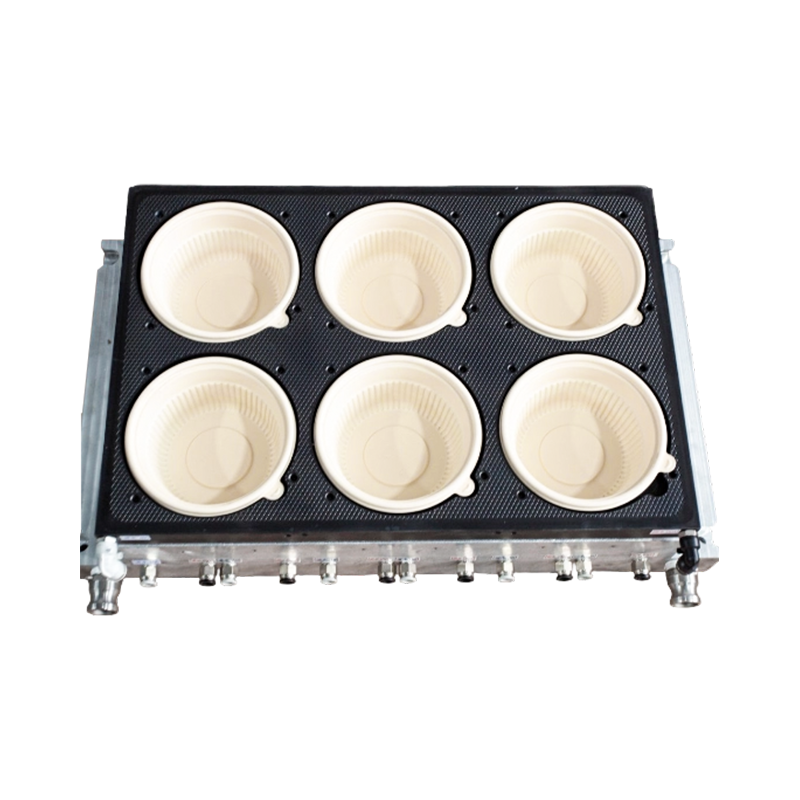
Food container mold manufacturing requires strict attention to surface finish (Ra ≤0.4µm for easy release and hygiene), cooling channel design, and material certification (FDA, EU 10/2011). For a lunch box thermoforming mold, aluminum is common for prototyping or medium runs, while hardened steel (P20, H13) is chosen for >1 million cycles in injection molds.
- Thermoforming mold features: Vacuum holes (0.5–1.0mm), polished cavity, no undercuts, often single‑sided.
- Injection molding mold features: Complex cooling circuits, ejector pins, slides for undercuts, multi‑cavity layouts (up to 64 cavities).
A manufacturer producing 10 million thin‑wall salad containers annually will typically invest in a multi‑cavity injection mold (48+ cavities) running on a 500‑ton press. Conversely, a regional lunch box supplier with 200,000 units/year will choose a lunch box thermoforming mold on a roll‑fed thermoforming machine, saving 70‑80% in tooling cost.
5. High-Volume Plastic Manufacturing: Matching Process to Scale
For high-volume plastic manufacturing exceeding 10 million parts annually, injection molding dominates due to its automation and multi‑cavity productivity. Modern injection molding lines produce 20,000+ parts/hour from a single mold. Thermoforming, even with in‑line trimming, typically maxes out at 8,000–12,000 parts/hour for similar‑sized containers.
However, thermoforming offers exceptional flexibility for seasonal products or frequent design iterations. Changing a thermoforming mold costs <$500 and takes one hour; injection mold changes require crane handling, re‑setting parameters, and often 4‑8 hours downtime. This makes thermoforming the preferred choice for short‑run private‑label food packaging (e.g., promotional lunch boxes).
Decision rule of thumb: Annual volume <1 million → thermoforming. 1‑5 million → evaluate both based on part complexity. >5 million → injection molding unless geometry is extremely shallow and design changes frequent.
6. Why Blow Molding Isn’t a Primary Contender for Lunch Boxes
Blow molding is occasionally mentioned alongside thermoforming and injection molding, but it serves a completely different segment: hollow objects such as bottles, jars, and jerrycans. The process cannot produce open trays or hinged containers without secondary cutting and sealing operations. For solid‑wall, thin‑wall food packaging like lunch boxes, clamshells, or microwave trays, neither extrusion blow molding nor injection blow molding is technically or economically viable. Therefore, the relevant comparison remains strictly between thermoforming and plastic injection molding.
7. Real‑World Performance Data (Industry Benchmarks)
Based on aggregated data from European and Asian food packaging manufacturers (2022‑2025), the following benchmarks illustrate the break‑even point between the two technologies for a typical 650ml rectangular lunch box (PP, 0.9mm wall).
Tooling Investment
Part Price (500k/year)
Part Price (5M/year)
These figures assume standard aluminum thermoforming molds and hardened steel injection molds with 4 cavities. The crossover point where injection molding becomes more economical usually lies between 1.8 and 2.5 million parts per year, depending on resin cost, cycle time, and labor rates.
8. Frequently Asked Questions (Food Packaging Molds)
Q1: Which process delivers lower scrap rate for thin‑wall lunch boxes?
Injection molding typically generates 2‑5% scrap (sprues, runners, reject parts), which is usually reground and reused. Thermoforming produces 15‑30% web scrap from sheet skeletons, though inline granulators can recycle this back into extrusion. For thin‑wall PP containers, thermoforming’s scrap is higher but lower energy consumption per part may offset material waste.
Q2: Can I use the same mold material for both processes?
No. Lunch box thermoforming molds are almost exclusively made from cast or machined aluminum (6061, 7075) for rapid heat transfer. Injection molds for food packaging require tool steel (P20, 420SS, H13) to withstand high clamp forces and melt pressure (500‑2000 bar). Using aluminum in injection molding would cause premature wear and deflection.
Q3: How do I estimate the break‑even quantity for my product?
Calculate total cost = mold cost + (part price × annual volume) for each process. For example, if thermoforming mold = $20k and part = $0.12, injection mold = $80k and part = $0.07, then solve 20k + 0.12V = 80k + 0.07V → 0.05V = 60k → V = 1.2M parts. Beyond 1.2 million pieces per year, injection molding becomes cheaper. This simplified model should also include maintenance, energy, and floor space.
Q4: Which process is better for biodegradable materials (PLA, PHA)?
Thermoforming is more forgiving with brittle bioplastics because the sheet is heated and formed with low shear stress. Injection molding of PLA requires precise moisture control and mold temperatures above 80°C to avoid brittleness. For high‑volume compostable lunch boxes, thermoforming currently leads due to wider processing windows.
Q5: Do thermoformed containers seal as reliably as injection‑molded ones?
Yes, as long as the flange flatness is maintained. Modern pressure‑formed molds achieve flange flatness within 0.1mm, suitable for peelable lidding films. Injection‑molded rims can achieve zero warp, but many high‑speed sealing lines perform equally well with quality thermoformed trays. Always request sealing trials with your specific film supplier.
Q6: How does mold maintenance differ between the two?
Thermoforming molds require frequent cleaning of vacuum holes and occasional polishing (every 50k‑100k cycles). Injection molds need preventive maintenance on ejectors, hot runner tips, and cooling channels every 200k‑500k cycles. Replacement parts for injection molds are more expensive but last longer.
9. Final Selection Matrix for Food Packaging Engineers
Choosing the right mold technology for food containers ultimately hinges on three variables: annual volume, part complexity, and time‑to‑market. Use the following checklist to align your project with the optimal process.
Both thermoforming machine and plastic injection molding technologies continue to evolve — servo‑driven forming stations, rapid mold change systems, and IML (in‑mold labeling) are pushing boundaries. For most standard lunch boxes and food trays, thermoforming offers the lowest risk path for new product launches, while injection molding becomes indispensable for billion‑part programs.