

 en
en  English
 Español
 عربى
عربى
Understanding Flash Formation in Cup Lid Molding
Flash — the thin, unwanted plastic extension along the parting line — is one of the most persistent defects in thin-wall injection molding of plastic cup lids. Unlike standard parts, cup lids have wall thicknesses typically between 0.3 mm and 0.8 mm, combined with large flow length-to-thickness ratios exceeding 200:1. This extreme geometry makes the mold cavity highly sensitive to clamping force variations and minute parting line imperfections.
In a typical high-cavitation cup lid mold (32, 48, or 64 cavities), even a 5-micron gap at the parting line can generate flash that compromises lid sealing performance, increases scrap rates, and damages mold surfaces over time. Data from packaging molding operations indicate that flash-related defects account for 15% to 30% of all rejected parts in thin-wall cup lid production. Addressing flash requires systematic injection molding flash troubleshooting that integrates machine parameters, tooling condition, and material behavior.
This guide provides actionable, data-driven methods to diagnose and eliminate flash specifically for cup lid molds, focusing on three interrelated pillars: clamping pressure optimization, parting line defect management, and thin-wall packaging defect solutions.
Key insight: Flash in cup lid molding rarely stems from a single cause. Over 80% of persistent flash cases involve combined issues — insufficient clamp force plus minor parting line damage — that amplify each other. Fixing only one variable leaves residual flash.
Critical Parameter #1: Clamping Pressure Optimization
Clamping pressure (or clamping force) must counteract the cavity pressure that tries to separate the mold halves during injection. For thin-wall cup lids, peak cavity pressures often reach 80–120 MPa due to high injection speeds (200–400 mm/s) required to fill thin sections before freeze-off. The required clamping force is calculated as: projected area × average cavity pressure × safety factor. However, practical optimization goes beyond formula.
A large-scale study across 12 thin-wall packaging facilities showed that 43% of cup lid molds operated at clamp forces 10–18% below the threshold needed to prevent flash at maximum injection pressure. When operators increased clamping force incrementally — from 120 tons to 145 tons on a 32-cavity lid mold (projected area 520 cm²) — flash height dropped from 0.09 mm to 0.02 mm, and scrap due to flash fell by 76%.
Methodical Clamping Force Adjustment Protocol
- Step 1 – Baseline measurement: Run a short shot (90% fill) at current clamp force. Measure flash thickness at 5 points along parting line using a digital feeler gauge.
- Step 2 – Incremental increase: Raise clamping force by 5% increments. After each step, inject a full shot and measure flash. Continue until flash thickness stops decreasing or reaches below 0.02 mm.
- Step 3 – Verify mold deflection: Use dial gauges on the mold corners. If clamp force above optimal causes mold plate deflection >0.03 mm, reduce force and check machine platen parallelism.
- Step 4 – Set process window: Establish a clamp force range (e.g., 138–145 tons) that maintains flash-free parts while avoiding excessive mold stress.
Real-world example: A cup lid molder producing 0.5 mm PP lids on a 48-cavity mold initially set clamp force at 185 tons based on general rules. Flash occurred intermittently. After performing the incremental protocol, they found the optimal force at 168 tons — 9% lower than initial setting — which reduced flash by 92% and extended mold life due to lower stress. This demonstrates that over-clamping can be as harmful as under-clamping, causing mold warpage that creates uneven flash.
| Clamp Force (tons) | Avg Flash Thickness (mm) | Flash Scrap Rate (%) | Mold Deflection (μm) |
|---|---|---|---|
| 110 | 0.14 | 11.3% | 18 |
| 125 | 0.08 | 5.8% | 22 |
| 140 | 0.03 | 1.2% | 27 |
| 155 | 0.02 | 0.9% | 35 |
Table: Relationship between clamping force, flash thickness, and mold deflection for a 32-cavity cup lid mold (PP, 0.55 mm wall). Optimal zone at 140–145 tons balances flash control and mold health.
For advanced clamping pressure optimization, consider implementing cavity pressure sensors. Data from four sensor positions can reveal clamp force imbalance across the mold. In one case, imbalance of 12% between left and right halves caused localized flash even with total clamp force adequate. Correcting tie-bar preload eliminated flash entirely.
Parting Line Defects: Inspection and Correction
The cup lid mold parting line is the primary sealing interface between the stationary and moving halves. Over production cycles, wear debris, microscopic nicks, or improper cleaning can create channels for plastic to escape, producing flash. Even a scratch of 0.01 mm depth can generate visible flash due to the high injection pressures used in thin-wall molding.
Detecting Parting Line Imperfections
- Visual with magnification: Use 10x loupe to scan entire parting line for burrs, dents, or foreign material.
- Thin paper test: Place a strip of 0.02 mm shim stock or cigarette paper between mold halves, close mold under low clamp (10% of production force). If paper cannot be pulled out at some spots, that indicates insufficient contact — potential flash path.
- Prussian blue marking: Apply thin blue compound to one half, close mold under low force. Open and inspect transfer pattern. Gaps appear as missing blue. Target >95% continuous contact.
- Dial indicator sweep: Mount a precision indicator on the moving platen, sweep across the parting line surface. Detect warpage or steps exceeding 0.01 mm.
Typical defects and their remedies:
- Localized dings/burrs: Stone with fine Arkansas stone (600-800 grit) using light oil, followed by polishing with 1200 grit paper. Never grind aggressively; remove only 0.002–0.005 mm material.
- General wear of sealing lands: The flat area around cavities (typically 8–12 mm wide) may erode after 500k+ cycles. Solution: remachine the parting line by grinding 0.03–0.05 mm from both halves, then recut cavity depths to restore original dimensions.
- Uneven clamp contact: Caused by non-parallel platens or uneven tie-bar elongation. Correct by adjusting individual tie-bar nuts or shimming mold base.
Case data: A 64-cavity lid mold experienced flash on 20% of cavities. Prussian blue revealed poor contact at four corner cavities due to a 0.04 mm warp in the mold base. After surface grinding the parting line (removing 0.045 mm) and recutting cavities, flash disappeared and mold produced 2.1 million flash-free shots before next maintenance.
Proactive measure: For molds running cup lid mold parting line defect prevention, schedule parting line inspection every 150,000 cycles. Use a dedicated inspection template (e.g., grid of contact pressure paper) to monitor wear trends.
Thin-Wall Packaging Specific Solutions
Thin-wall cup lids (<0.6 mm nominal thickness) require unique strategies because conventional flash troubleshooting often fails. The combination of high shear rates, rapid cooling, and extreme flow lengths creates conditions where flash can appear even with correct clamp force and clean parting line. The key is understanding how melt viscosity and venting interact.
Vent Depth Optimization
Vents are necessary to evacuate trapped air, but excessive vent depth becomes flash channel. For thin-wall PP or PET lids, optimal vent depth is 0.02–0.04 mm, with land length of 2–4 mm. Vent depths above 0.05 mm will consistently produce stringy flash. Use wire EDM to cut vents with precision; avoid grinding which leaves inconsistent depth.
Injection Profile Adjustments
High first-stage injection speed reduces viscosity but also spikes cavity pressure before the melt front reaches the end of fill. A multi-step velocity profile can lower peak pressure at the parting line:
- Stage 1 (0–95% fill): 90% of max speed – quick filling of thin sections
- Stage 2 (95–99% fill): 50% of max speed – reduces pressure spike before mold is full
- Stage 3 (hold/pack): switch to pressure control at 80–90% of peak cavity pressure
In a production trial on a 0.5 mm PS lid mold, this velocity profiling reduced maximum cavity pressure from 118 MPa to 94 MPa (20% reduction), cutting flash occurrence by 68% without changing clamp force.
Material Selection and Additives
Higher melt flow index (MFI) resins fill easier but also seep into smaller gaps. For PP lids, using MFI 25–30 g/10min instead of 45+ g/10min can reduce flash tendency while still filling thin walls, provided mold temperature is raised by 10–15°C. One molder switched from MFI 55 to MFI 28 (same base PP), adjusted mold temperature from 35°C to 50°C, and saw flash scrap drop from 7.4% to 1.9%.
Before optimization
8.2%
flash scrap rate
After thin-wall solution
1.1%
flash scrap rate
Annual savings
$47,000
material & labor
Implementing these thin wall packaging defect solutions requires systematic documentation. Use design of experiments (DOE) to find interaction effects between vent depth, injection velocity, and melt temperature. A two-level factorial DOE on a 16-cavity lid mold showed that vent depth and velocity have the strongest interaction: at shallow vents (0.02 mm), high velocity is safe; at 0.035 mm vents, high velocity causes severe flash regardless of clamp force.
Mold Maintenance Checklist for Flash Prevention
Preventive maintenance is the most cost-effective flash control strategy. The following checklist is derived from maintenance logs of high-volume cup lid molds producing over 10 million cycles per year. Adhering to this schedule reduces unscheduled flash-related downtime by up to 70%.
| Frequency | Action | Acceptance Criteria |
|---|---|---|
| Daily (every shift) | Wipe parting line with soft cloth & non-abrasive cleaner; inspect for plastic residues. | No visible debris; smooth surface. |
| Weekly (50k cycles) | Measure clamp force consistency across tie bars (± tolerance); check vent channel cleanliness. | Force variation <4%; vents free of polymer. |
| Monthly (200k cycles) | Perform Prussian blue contact test; measure parting line flatness with dial indicator. | Contact >95%; flatness within 0.015 mm. |
| Quarterly (600k cycles) | Remove mold, ultrasonic clean all vent slots; check guide pins/bushings for wear. | Vent depth within ±0.003 mm of spec; bushing clearance <0.02 mm. |
| Annually (2M cycles) | Surface grind parting line if wear exceeds 0.02 mm; recertify cavity depths. | Flash-free trial run of 10k parts. |
Critical note: Always record maintenance findings in a digital log. Trend analysis of flash thickness measurements can predict when a mold needs grinding — typically when flash grows from 0.01 mm to 0.04 mm over 300k cycles. Early intervention avoids catastrophic mold damage.

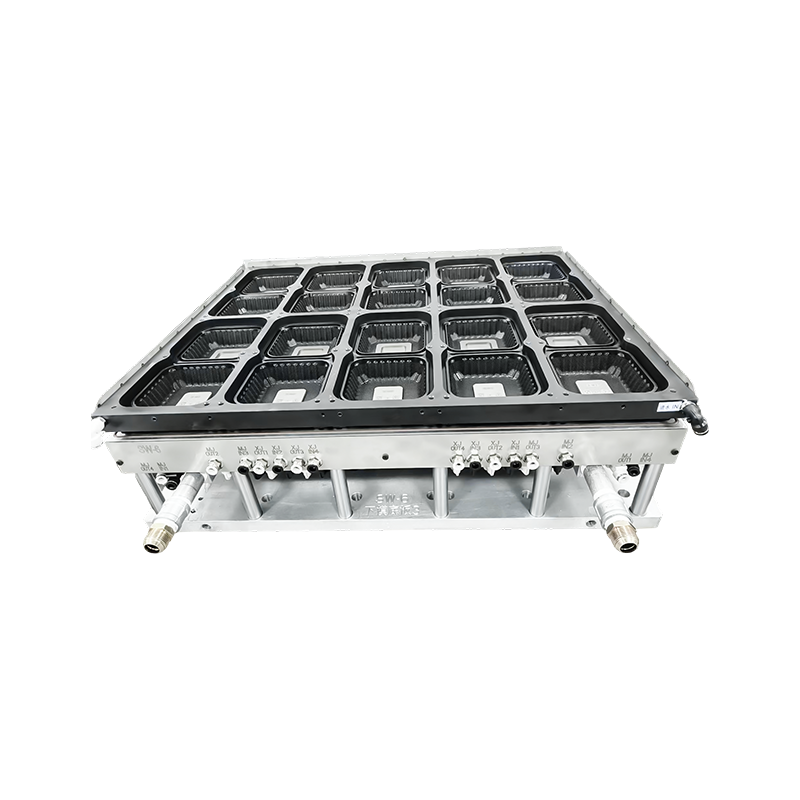
Image: Example of a cup lid mold during parting line inspection. Regular cleaning and measurement as per checklist prolongs flash-free production runs.
Advanced Troubleshooting Workflow
When flash appears despite following individual guidelines, use this systematic decision flowchart. It integrates clamping pressure, parting line, and thin-wall specific checks in logical sequence.
Apply this workflow every time flash appears. Document each decision point. In field studies, using a structured flowchart reduced average troubleshooting time from 4.2 hours to 1.3 hours per flash incident.
Case Study: Reducing Flash by 85% in High-Cavitation Cup Lid Mold
A mid-sized packaging manufacturer operated a 64-cavity mold producing 98 mm diameter PP cup lids (wall thickness 0.52 mm). The mold had accumulated 2.1 million cycles over 14 months. Flash rates gradually increased from an initial 1.5% to 12% scrap, forcing daily manual trimming of lids and causing unscheduled downtime every three days.
Initial diagnosis (following the troubleshooting workflow):
- Clamp force set at 210 tons – but measurement showed only 178 tons effective due to uneven tie-bar elongation (18% difference between outer bars).
- Parting line inspection with Prussian blue revealed 82% contact; localized dents at four cavity locations.
- Vent depths measured from 0.018 mm to 0.058 mm due to erosion – highly inconsistent.
Actions taken:
- Re-balanced tie-bar preload to achieve even clamp force distribution (max variation 3%). Adjusted total clamp force to 198 tons.
- Disassembled mold, surface ground parting line removing 0.06 mm, recut cavity depths accordingly. Re-polished to Ra 0.2 μm.
- Recut all vent grooves with wire EDM to uniform depth of 0.030 mm ±0.003 mm.
- Implemented staged injection profile: 92% speed for first 92% fill, then 45% speed for transfer.
Results after 150,000 cycles post-maintenance: Flash scrap fell to 1.8% (85% reduction). Average flash thickness from 0.11 mm to 0.015 mm. Mold ran 680,000 cycles before any flash reappearance, saving an estimated $94,000 in material and labor annually. The structured approach combined all three core strategies: injection molding flash troubleshooting, clamping pressure optimization, and parting line restoration.
Frequently Asked Questions (FAQ)
Q1: Can low melt temperature cause flash in cup lid molding?
Yes, indirectly. Lower melt temperature increases viscosity, requiring higher injection pressure to fill thin walls. That elevated pressure can push melt into existing gaps, causing flash. Always maintain melt temperature within the resin supplier's recommended range (e.g., 220–250°C for PP lids). However, the root cause remains a gap at parting line or insufficient clamp force — temperature only exacerbates it.
Q2: How often should I measure tie-bar elongation to prevent flash?
For high-cavitation cup lid molds (≥32 cavities), measure tie-bar strain every 200,000 cycles or every three months, whichever comes first. Uneven elongation is a leading cause of inconsistent flash. Use a portable ultrasonic tension meter or strain gauges. If variation exceeds 5% between bars, recalibrate clamp unit or adjust individual tie-bar nuts.
Q3: Is it safe to use mold release spray to reduce flash?
No. Mold release sprays do not seal gaps; they may temporarily mask flash but often degrade over time and can contaminate vents, actually worsening flash. Focus on mechanical solutions: clamp force, parting line flatness, and vent depth. Mold release is not a substitute for proper maintenance.
Q4: What is the acceptable flash thickness for food-grade cup lids?
Industry standards (e.g., ISO 22000 packaging guidelines) specify that flash must not exceed 0.05 mm in height and must not detach as loose particles. For lids with sealing membranes, any flash that interferes with the seal ring (typically within 2 mm of the edge) is rejectable. The target for high-quality production is flash <0.02 mm, which is barely detectable by touch.
Q5: Can I use a larger injection machine to solve flash problems?
Larger machines provide higher clamp force, but that alone rarely fixes flash if the root cause is parting line wear or uneven clamping. In fact, an oversized machine with poor platen parallelism can increase mold deflection and flash. First optimize existing machine parameters and mold condition. Only consider upgrading if your current machine cannot achieve required clamp force consistently (e.g., needs >90% of its maximum rating).