

 en
en  English
 Español
 عربى
عربى
Engineering Demands Behind Specialized Container Packaging
Container packaging molds sit at the intersection of two competing goals: they must hold tight geometric tolerances while surviving thousands of repetitive cycles under heat and pressure. A single deviation of a few tenths of a millimeter in draft angle or wall thickness can turn a smooth-release cavity into one that snags every third part, slowing an entire production line.
Buyers evaluating tooling options often focus on price per cavity, but the more consequential variable is mold design quality: how draft angles, venting patterns, and cooling channels are laid out before a single block of aluminum or steel is machined. Poorly planned venting alone can account for a measurable share of scrap in high-speed thermoforming lines.
Tooling accuracy determines packaging consistency long before the first sheet ever reaches the heating station.
Round Lidless and Rectangular Clamshell Mold Architectures Compared
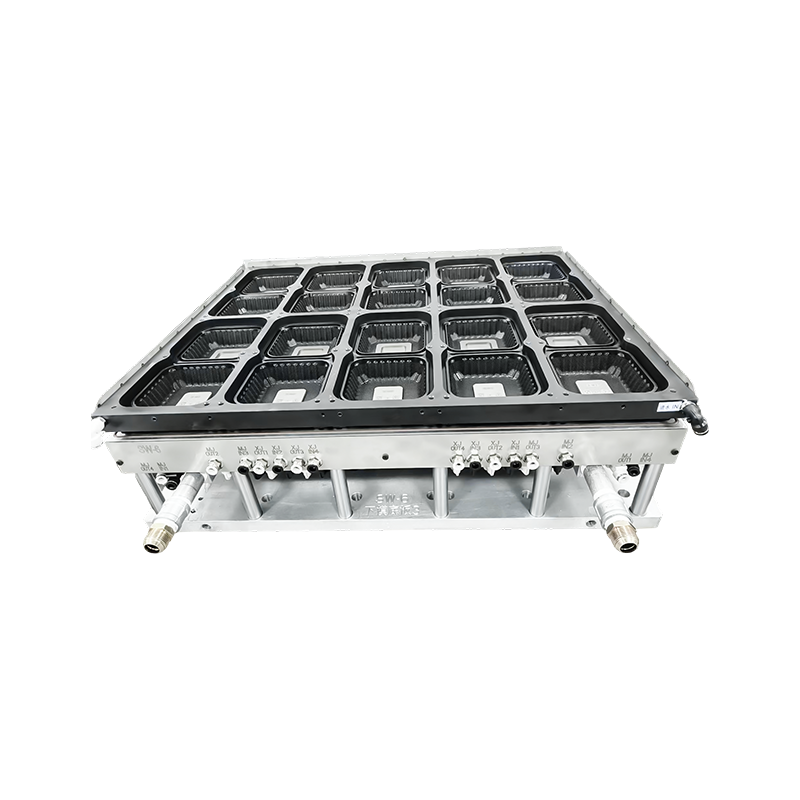
Container packaging typically falls into two dominant shell families: round lidless trays and rectangular clamshell boxes. Each demands a distinct cavity layout, trim ring design, and cooling strategy.
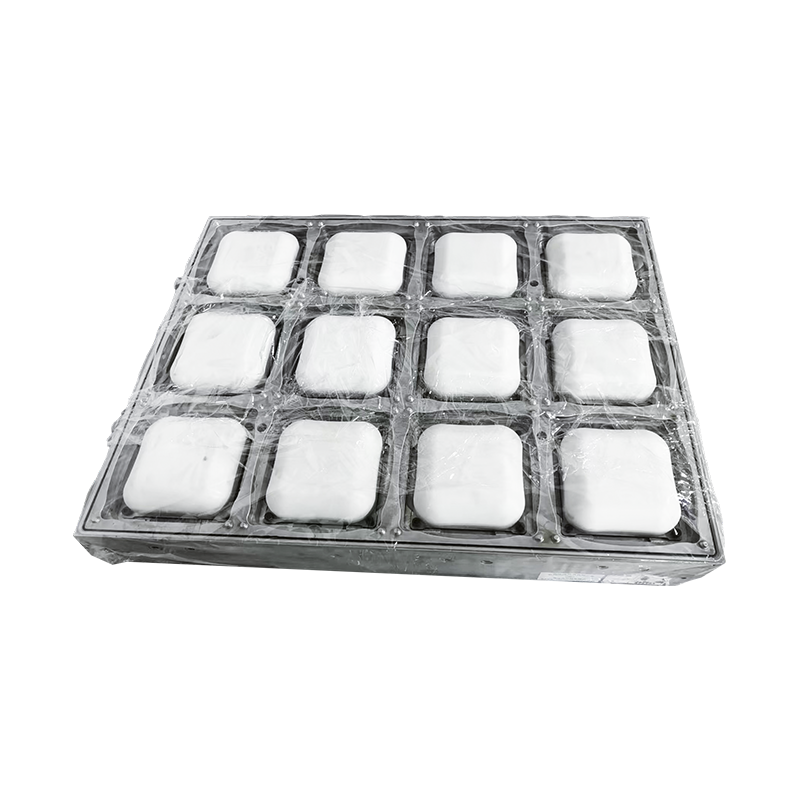
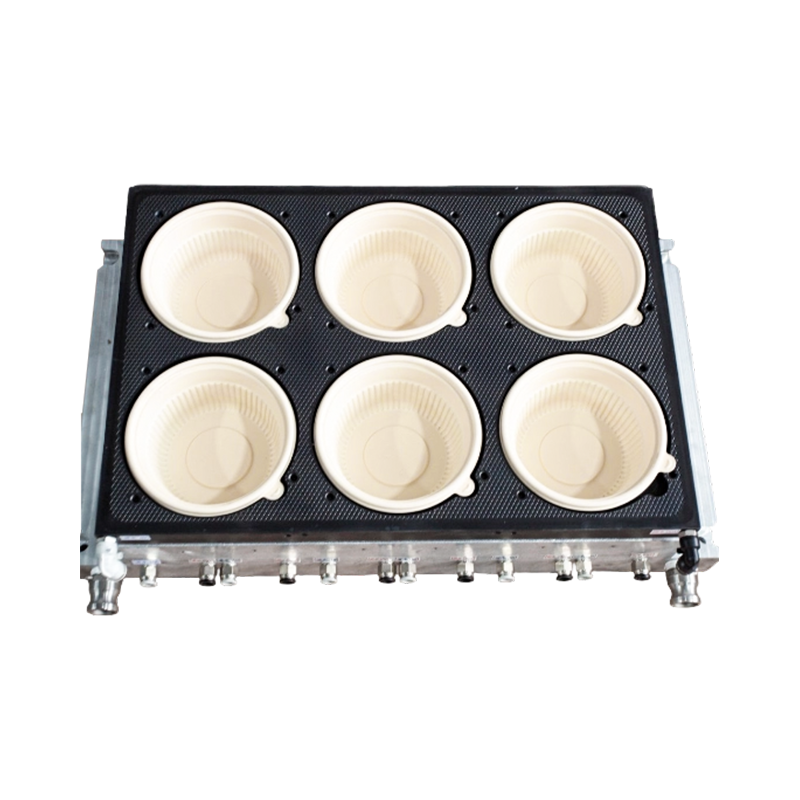
A round lidless packaging box thermoforming mold relies on radially symmetric draft to allow uniform material distribution from a single sheet blank, which reduces localized thinning at the rim. A rectangular clamshell packaging box thermoforming mold instead must manage four distinct corner radii plus a continuous hinge line, which is typically the single hardest feature to vent evenly.
| Attribute | Round Lidless Mold | Rectangular Clamshell Mold |
|---|---|---|
| Typical draft angle | 3 to 5 degrees | 2 to 4 degrees at corners |
| Critical stress zone | Rim and base transition | Hinge line and corner radius |
| Venting pattern | Radial, evenly spaced | Concentrated near hinge and corners |
| Typical wall thickness | 0.35 to 0.55 mm | 0.30 to 0.50 mm |
| Average cycle time | 4 to 6 seconds | 5 to 8 seconds |
From Vacuum Forming Plastic Sheet to Finished Cavity
Regardless of shell geometry, the underlying process shares a common sequence. Understanding each stage helps explain why mold surface finish and vent placement have outsized influence on part quality.
Consistent vacuum forming plastic results depend heavily on how quickly vacuum draws air from behind the sheet. Mold designers place vent holes near the deepest draw points first, since these areas cool last and are most prone to webbing or incomplete detail.
Precision Injection Molding versus Thermoforming: Where Each Excels
Container packaging manufacturers frequently weigh thermoformed shells against injection molded components for accessory parts such as rigid trim rings, snap-fit lids, or structural inserts. Neither process is universally superior; each suits different volume and geometry profiles.
- Precision injection molding delivers tighter dimensional repeatability, typically within a few hundredths of a millimeter, making it suitable for interlocking or snap-fit features.
- Thermoforming handles larger, thinner-walled shells more economically at high volume, since sheet material cost per part is lower than injection resin for equivalent surface area.
- Injection tooling generally carries a longer lead time and higher upfront cost due to more complex core and cavity machining.
- Thermoform molds can often be modified or re-cut faster when a design revision is needed mid-production.
| Factor | Precision Injection Molding | Thermoforming |
|---|---|---|
| Wall thickness control | Very tight | Moderate |
| Best fit volume | Small structural parts, high runs | Large shells, mid to high runs |
| Tooling lead time | Longer | Shorter |
| Material cost per part | Higher for large parts | Lower for large parts |
The Role of 3D Printing Manufacturing in Mold Prototyping
3d printing manufacturing has become a common intermediate step before committing to metal tooling. Engineers print scaled cavity sections to verify draft angles, hinge clearances, and vent placement before final machining begins.
One recurring defect during early prototype iterations is plastic string, a thin filament residue left behind when a printed tool head transitions between features without fully retracting molten material. While cosmetic on a prototype, this same stringing behavior offers a useful diagnostic: if a printed mold surface shows persistent stringing near a particular contour, that same contour often produces webbing or drag lines once scaled to production tooling. Catching this early avoids costly rework after steel or aluminum cavities are already cut.
Manufacturing Process Optimization Strategies for High-Volume Runs
Once a mold design for either a clamshell mold tooling program or a round lidless line is finalized, ongoing performance depends on disciplined process control rather than one-time design decisions.
Cycle Time
Shaving even half a second per cycle across a high-speed line compounds into meaningful daily output gains.
Scrap Rate
Tracking scrap by cavity position often reveals a single underperforming vent hole rather than a systemic issue.
Sheet Utilization
Nesting cavity layout more tightly on the sheet reduces trim waste without altering part geometry.
Tool Maintenance
Scheduled vent cleaning prevents gradual buildup that slows vacuum draw over months of continuous use.
Effective manufacturing process optimization is rarely a single fix. It is the accumulation of small, measured adjustments: heater zone balancing, sheet preheat timing, and mold temperature consistency, each tracked over time rather than judged from a single production run.
- Baseline current cycle time and scrap rate before making any change.
- Adjust one variable at a time, such as heater zone temperature.
- Record results across at least several hundred cycles for statistical relevance.
- Document the change and revert if no measurable improvement appears.
Frequently Asked Questions
Q1: What determines whether a round or rectangular mold shape is chosen for a packaging line?
The decision usually follows the product being packaged. Round lidless shells suit items that benefit from uniform radial support, while rectangular clamshells suit products needing a hinged, self-contained enclosure.
Q2: How does vacuum forming plastic differ from injection molding in terms of tooling cost?
Vacuum forming tooling is generally less expensive to produce and modify, since cavities are typically machined from aluminum rather than hardened steel, though it trades away some dimensional precision compared to injection molding.
Q3: Why does plastic string appear during 3d printing manufacturing of mold prototypes?
Stringing occurs when molten material oozes from the print head while moving between separate features without adequate retraction. It is a common early-stage indicator worth monitoring before finalizing cavity geometry.
Q4: How often should a thermoforming mold be serviced to maintain consistent output?
Maintenance intervals depend on cycle volume, but many operations schedule vent inspection and cleaning on a recurring basis to prevent gradual drops in vacuum draw efficiency.
Q5: Can a single mold design optimization strategy apply to both round and rectangular shell types?
Core principles such as balanced venting and gradual single-variable testing apply broadly, but specific parameters like corner radius handling differ enough that each shell type benefits from its own tuning pass.